|
Home Page | Order Challenger Video | Be Notified Of Web Site Updates | Contact Us
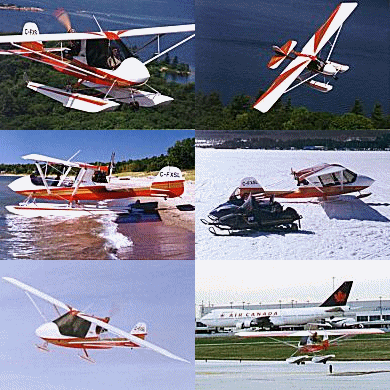
Herein are the older Challenger II 447 Legacy, 503 Deluxe, 582 Premium
which have been replaced by new 582 powered Challenger Light Sport models.
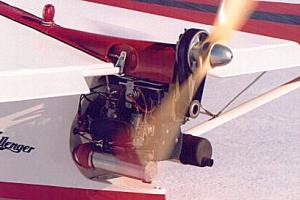
The newest Rotax 503 and 582 engines are ASTM certified. Purpose built for aviation they have earned top marks for reliability as well as easy, affordable maintenance. Dual independent electronic ignition systems fire two spark plugs per cylinder for redundancy plus more power and lower fuel usage. A taller redrive and bigger prop increase takeoff, climb and cruise performance. Historically the most common powerplant for Challengers was the Rotax 503.
The 582 Power Pack is by far the best solution for flying missions
on floats, especially with a passenger. It is particularly well suited to carrying
heavy loads or operating at high density altitudes. The 582 produces 30% more
horsepower than the 503 and actually uses less fuel. The new Blue Head
The additional thrust generated by the 582 Power Pack's combination of engine, redrive and prop converts directly into dramatic takeoffs and quicker climbs plus higher cruise speeds. The new 2011 Challenger Light Sport XL-65 has a gross weight increase to 1060 lbs due in part to the capability of the 582 Power Pack! The 582 gives scintillating performance on the Challenger. Many people say that the 582 plane on floats performs like the floats aren't there and that the 582 flies with a passenger like a 503 flies solo! For more info on the 582 as well as videos showing 582 and 503 Challengers performing side by side click here.
Rotax 503 & 582 Engines | 2.6-to-1 Reduction Drive | 60 Inch Prop
The versions of the Rotax 503 and 582 engines used in all new Challengers were developed expressly for use in aircraft based on substantial real world experience with their predecessors. In June 2006 new 582 UL DCDI Model 99 engines were certified as meeting the demanding US Light Sport Aircraft ASTM standards. In June 2010 new 503 UL DCDI engines were certified as being ASTM compliant. The 582 and 503 are now equals to the 4-stroke 912 and 914. Numerous improvements have been incorporated, starting deep inside with a heavy duty crankshaft and redesigned bearings. The new 582's have a hydro-damper on the flywheel to reduce internal vibration. On the outside, a new dual ball joint exhaust system isolates the muffler from vibration and improves engine breathing. Other changes are less visible but no less important. Dual independent electronic ignition systems provide redundancy and eliminate the need for timing adjustments. Two spark plugs per cylinder also contribute to redundancy and yield a more efficient fuel burn. Plug fouling is no longer an operational concern. Twin carbs provide the correct fuel-air mixture to each cylinder. Taken all together, this significantly increases power and lowers fuel consumption, benefiting performance, range and endurance. The new Rotax 582 Model 99, known as the Blue Head, has replaced the older Model 90, known as the Grey Head. Oil injection is now standard and dual oil tanks support 10-12 hours of cruise. The Blue Head has a number of important design changes which lead to significant improvements in reliability over the Grey Head. Two of these changes in particular yield major benefits. A new ceramic water pump seal replaces the previous rubber seal and is backed up by an oil seal on the reservoir side thus eliminating the problem of leaking cross shaft seals. This together with the new dexcool long life coolant designed for aluminum block engines has eliminated cross shaft replacements. A new thermostatically controlled bypass circuit recirculates coolant through the engine until it reaches operating temperature. The new thermostat then opens gradually rather than abruptly to circulate coolant to and from the radiator. The new by-pass circuit and thermostat together address the shock cooling and cold seizures which occasionally occurred on the Grey Head. The 582 and 503 with their high power-to-weight ratios provide plenty of power for the light weight Challenger with its large wing. By comparison, the much heavier liquid-cooled Rotax 912 engine, required by aircraft similar to the Challenger but which weigh more and have smaller wings, costs $20,000! The 582 and 503 cost a third less to operate and when the time comes a full overhaul including new crankshaft and pistons is only $2,500-3,000. The Rotax 912 has a longer TBO but an overhaul costs around $15,000. In typical usage in the real world the 582/503 overhaul expenses will be half as much per hour. Most people maintain the 582 and 503 "on condition", with no predetermined time between overhaul (TBO). They have the engine inspected at regular intervals and do whatever is required to ensure everything is within spec. The time between inspections on the new 582 and 503 is 300 hours, versus 150 hours for the older versions. This gives much lower cost per hour figures than engines with higher TBO's since they have dramatically higher overhaul costs. And unlike the 912 and other oil sump engines found in general aviation aircraft, the 582 and 503 require no inconvenient and time-consuming preheating, even in Canada's nastiest winters! Just turn the key and go! The new cog drive has teeth on the belt which engage with machined
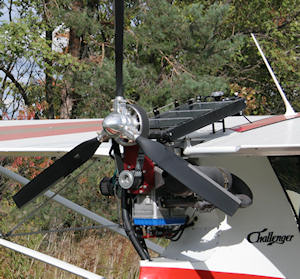
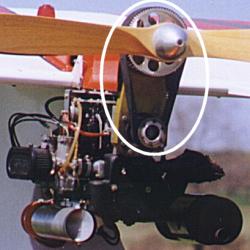
grooves on both upper and lower pulleys. The cog belt dampens vibration and provides the positive engagement of a gearbox without drivetrain lash. Unlike a gearbox, the cog belt uses no oil bath, so it requires no preheating - no matter how frigid the air. Obviously a major benefit in Canada! The cog belt dampens vibration and provides the positive engagement of a gearbox without drivetrain lash. Unlike a gearbox, the cog belt uses no oil bath, so it requires no preheating - no matter how frigid the air. Challengers use cog belt reduction drives instead of gearboxes, even though the manufacturing cost is higher. This more elegant approach is lighter, less complex, and more reliable. The redrive tower elevates the prop higher than a gearbox which allows the engine to be mounted inverted behind the fuselage out of the slipstream, instead of upright on top of the wing creating drag. This lower drag inverted mounting approach is yet another advantage of using the 582 and 503 rather than a 912 or other four stroke engine. The 582 and 503 were designed by Rotax for both inverted and upright applications. A mixture of oil, fuel and air enters through the intake manifold and is then sucked into the crankcase through a port in the cylinder. In the crankcase this pressurized mist performs the lubrication function before being routed through another port back to the cylinder for combustion. In the 582 and 503 this lubrication process is not driven by gravity or pumps. Instead it uses simple ports and changes in pressure as the pistons go up and down. The 582 and 503 don't know or care whether they are upright or inverted. With a 912 or other four stroke engine a pump moves oil from a sump at the bottom of the engine to the top then gravity takes over to feed the oil down through the components needing lubrication. If that type of engine is inverted it seizes. With the 582 and 503 there is no possibility of hydraulic locks and with the new models there are no plug fouling concerns. The new 2.6-to-1 reduction drive is taller than its predecessors, providing clearance for a longer 60" propeller. The 60" props turn at 2,100 rpm in cruise which is much more efficient than the 2,600 rpm rate of the shorter redrives. Decibels are down and the lower pitched sound is quite pleasing. Older Challengers have 2.2-to-1 redrives with a 54" props or 2.1-to-1 units with 52" props. Both deliver much less performance than the 2.6/60" combo. The Canadian Challenger 582 Power Pack comes with the top-of-the-line Warp Drive 3-blade ground adjustable prop with carbon fibre blades with wide tips. An available option upgrades the Warp Drive to the HP-L hub and adds Leading Edge Protection. The machined aluminum HP-L hub makes tracking easier and it's lighter and prettier than the STD hub. The solid nickel leading edges protect the blades from spray, slush and rain. Leading edge protection is strongly recommended for operations on floats. For the 503 the best prop is a 2-blade fixed pitch wooden prop which is the lightest and most economical choice. Optional Uralight hard epoxy inserts provide leading edge protection to prevent erosion from spray, slush and rain.
For a comparison of the 582 and 503 Power Packs click here. For details on the configuration of the Power Packs click here for the 582 and here for the 503.
To learn and see more order our comprehensive information package and video! |